What a USD corporate account is, in one paragraph
A USD corporate account is a business account denominated in US dollars. It is not the same thing as a bank account inside the United States. The institution holding your balance may sit in another jurisdiction entirely, which is precisely why a company registered in India, Nigeria, Vietnam, Brazil or the UAE can hold and move dollars without incorporating a US entity, obtaining a US tax number or setting foot in the country.
Monvenience arranges these accounts for companies registered outside the United States. Your balance is multi-currency, so dollars sit alongside the other currencies you trade in. Payments move by conventional bank transfer, and the same account settles in USDT and USDC when your counterparty prefers a stablecoin. One dashboard, two dollar rails, one compliance file.
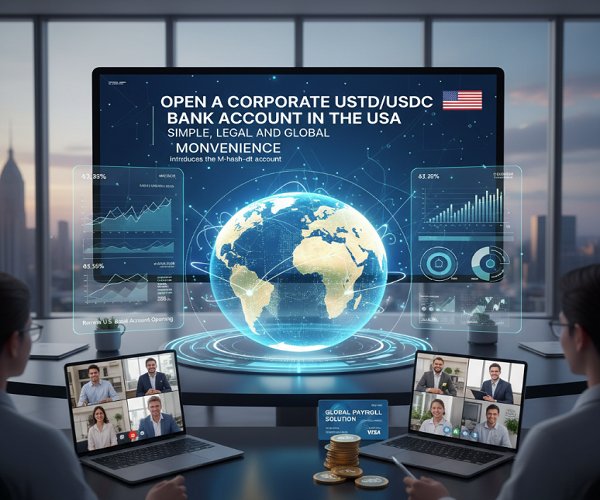
A dollar account built for companies that trade across borders
Dollars, Plus the Currencies You Actually Invoice In
Hold US dollars alongside other major currencies in one account. Collect in the currency your customer pays, settle in the currency your supplier wants, and convert when the rate suits you instead of at the moment funds land.
Two Dollar Rails, One Account
Send and receive by conventional bank transfer, or settle the same invoice in USDT or USDC when speed and cost matter more. You choose per payment rather than per provider, and both sides sit under one compliance file.
Corporate Cards on the Same Balance
Issue cards to named employees with per-card spending limits, funded from the account balance. Useful for advertising spend, SaaS subscriptions and travel that would otherwise sit on a director's personal card.
What you get, stated plainly
| Account holder | Your company, in its registered name. Not a personal account, and not a pooled wallet. |
| Base currency | US dollars, with additional major currencies held on the same account. |
| Account identifiers | Issued on approval. The identifier set depends on the institution that onboards you and the corridors you trade in; your exact details are confirmed before you go live. |
| Conventional payments | International transfers in and out, for supplier settlement, customer collections and intercompany movements. |
| Stablecoin settlement | USDT and USDC, inbound and outbound, subject to counterparty and source-of-funds checks. |
| Cards | Corporate cards for named employees, funded from the account balance, with limits set per card. |
| Company registration required | Any eligible jurisdiction outside our restricted list. A US entity is not required. |
| Onboarding | Fully remote. Document submission and verification are completed online. |
Why we do not publish a single account number format. Dollar accounts are issued under different arrangements depending on your company's jurisdiction, sector and expected flows. Providers that advertise one fixed identifier set to every applicant are describing one product; we would rather match you to the arrangement that clears your actual payments and confirm the details in writing before you commit.
Why companies are adding a second dollar rail
Two things changed at once. Dollar access got harder for companies without a US or European footprint, as correspondent banking relationships thinned out across emerging markets. And stablecoin settlement stopped being experimental.
Business-to-business stablecoin payments grew roughly 733% year on year in 2025 to an estimated $226 billion, accounting for about 60% of genuine stablecoin payment activity, according to analysis published by McKinsey and Artemis Analytics in February 2026. A Cybrid survey of 468 executives, reported in mid-2026, found 42% of businesses already using stablecoins for cross-border payments, with respondents citing average cost savings of about 35%, rising to around 47% for firms moving more than $100 million a month. In EY-Parthenon's 2025 survey of corporate and financial institution executives, cross-border supplier settlement was named the leading reason to adopt.
The pattern behind those numbers is consistent: the adopters are not crypto companies. They are importers, exporters, digital goods sellers, agencies and technology firms, using a second rail for the payments where a correspondent bank transfer is slow, expensive or simply unreliable on that corridor.
Sources: McKinsey & Artemis Analytics (February 2026); Cybrid executive survey (2026); EY-Parthenon Stablecoin Survey (2025). Figures are third-party market estimates, not Monvenience performance data.

How this compares to the alternatives
| Local bank in your country | Fiat-only payment account | Monvenience | |
|---|---|---|---|
| Dollar account without a US entity | Sometimes, with restrictions | ✓ Usually | ✓ Yes |
| Remote onboarding | ✗ Branch visit typical | ✓ Yes | ✓ Yes |
| Multi-currency on one balance | Varies by bank | ✓ Yes | ✓ Yes |
| USDT / USDC settlement | ✗ Rarely available | ✗ Not supported | ✓ Inbound and outbound |
| Switch rails per payment | ✗ No | ✗ No | ✓ Choose per transaction |
| Compliance file | One relationship | One relationship | One file across both rails |
Comparison describes typical market categories rather than any named provider. Individual providers differ, and you should verify current terms directly with any option you are considering.
Who this account is built for
Import, Export & Commodity Trade
Traders settling in dollars across corridors where correspondent transfers are slow or intermediary charges are only disclosed on arrival. Pay a supplier the same day when the shipment schedule will not wait.
Digital Goods, SaaS & Agencies
Software firms, agencies and consultancies invoicing overseas clients in dollars. Digital goods and technology are consistently among the largest business categories by stablecoin payment volume.
E-commerce & Cross-Border Retail
Sellers taking dollar revenue from several markets who need one place for it to land, plus card spend for advertising and platform fees on the same balance.
Distributed Teams & Contractor Payroll
Companies paying developers, designers and support staff in a dozen countries, where a single payment run beats a dozen separate remittance arrangements.
Group Treasury & Holding Structures
Groups moving funds between entities in different jurisdictions who want dollar balances visible in one dashboard rather than reconciled across four banks.
Licensed Financial & Digital Asset Firms
Regulated businesses that need conventional and stablecoin settlement side by side. Send your licence with the application, as it usually determines the outcome.
How it works
Submit Application
Complete the online form with your company details, business model and expected payment flows. No physical presence required.
KYB Verification
Upload incorporation documents, ownership structure and director identification. Compliance reviews complete applications within 48 hours.
Account Activation
You receive your account details in writing and gain access to the dashboard. Typically three to five business days end to end.
Start Settling
Collect and pay in dollars and other currencies, settle in USDT or USDC where it suits, and issue cards to your team.
Compliance, in advance rather than after the fact
Dollar accounts are declined far more often for a thin application than for a weak business. We front-load the compliance work so the decision arrives quickly and holds.
- KYB and beneficial ownership. Every owner above the applicable threshold is identified and verified, along with directors and controllers. Complex or nominee structures are workable, but they need to be explained rather than discovered.
- Source of funds and business rationale. We ask what your company does, who pays it and who it pays. A clear answer with a live website resolves most queries before they become one.
- Ongoing transaction monitoring. Applies to conventional and stablecoin flows alike, including counterparty screening on incoming stablecoin transfers.
- A regulated stablecoin environment. Payment stablecoins are now governed by dedicated law in major markets. The GENIUS Act was enacted in the United States on 18 July 2025, with effect from the earlier of 18 January 2027 or 120 days after final implementing rules; the European Union regulates the same instruments under MiCA. Holding and settling in USDT or USDC is a mainstream treasury activity, not a workaround.
- Restricted jurisdictions. Some countries and sectors are outside what our partners permit. Our restricted jurisdictions list is published so you can check before you spend time on an application.

List of Restricted Countries for Banking
| Sl No. | Country |
|---|---|
| 1 | Belarus |
| 2 | Crimea (Disputed Region, Ukraine) |
| 3 | Cuba |
| 4 | Democratic Republic of the Congo |
| 5 | Donetsk & Luhansk (Ukraine, Russian-Occupied Regions) |
| 6 | Iran |
| 7 | Libya |
| 8 | Myanmar (Burma) |
| 9 | North Korea (DPRK) |
| 10 | Russia |
| 11 | Somalia |
| 12 | South Sudan |
| 13 | Sudan |
| 14 | Syria |
| 15 | Venezuela |
| 16 | Yemen |
List of Restricted Countries for Card Program
| Sl No. | Country |
|---|---|
| 1 | Afghanistan |
| 2 | Akrotiri |
| 3 | Albania |
| 4 | Antarctica |
| 5 | Armenia |
| 6 | Ashmore and Cartier Islands |
| 7 | Bassas da India |
| 8 | Belarus |
| 9 | Bosnia-Herzegovina |
| 10 | Bouvet Island |
| 11 | Burundi |
| 12 | Central African Republic |
| 13 | Clipperton Island |
| 14 | Coral Sea Islands |
| 15 | Cuba |
| 16 | Cyprus |
| 17 | Democratic Republic of Congo |
| 18 | Dhekelia |
| 19 | Ethiopia |
| 20 | Europa Island |
| 21 | French Southern and Antarctic Lands |
| 22 | Glorioso Islands |
| 23 | Guatemala |
| 24 | Guinea |
| 25 | Guinea Bissau |
| 26 | Haiti |
| 27 | Heard Island and McDonald Islands |
| 28 | Iran, Islamic Republic |
| 29 | Iraq |
| 30 | Juan de Nova Island |
| 31 | Lebanon |
| 32 | Libya |
| 33 | Mali |
| 34 | Moldova |
| 35 | Montenegro |
| 36 | Myanmar |
| 37 | Navassa Island |
| 38 | Nicaragua |
| 39 | Niger |
| 40 | North Korea |
| 41 | Paracel Islands |
| 42 | Pitcairn Islands |
| 43 | Russian Federation |
| 44 | Serbia |
| 45 | Somalia |
| 46 | South Georgia and the South Sandwich Islands |
| 47 | South Sudan |
| 48 | Spratly Islands |
| 49 | St Kitts & Nevis |
| 50 | Sudan |
| 51 | Syria |
| 52 | Tromelin Island |
| 53 | Tunisia |
| 54 | Turkey |
| 55 | Ukraine |
| 56 | Vanuatu |
| 57 | Venezuela |
| 58 | Wake Island |
| 59 | Yemen |
| 60 | Zimbabwe |
Frequently Asked Questions (FAQ)
Yes. A USD account is a dollar denominated account, not necessarily an account held at a bank inside the United States. Your company can be incorporated in most jurisdictions and still hold, receive and send US dollars through our platform. You do not need a US entity, a US address or a US tax identification number.
No, and the difference matters. A US bank account is opened at an institution inside the United States and is identified by a routing number and an account number. A USD account is any business account denominated in US dollars, and the institution holding it may sit outside the United States. Both let you hold and move dollars. Which identifiers and payment rails your account receives depends on the institution that approves it, and those details are confirmed to you at onboarding.
The account is multi-currency. US dollars sit alongside other major currencies so you can invoice, collect and pay in the currency your counterparty uses, and convert when the rate suits you rather than at the moment funds arrive. The exact currency set available to your company is confirmed during onboarding.
USDT and USDC are payment stablecoins, each intended to hold a value of one US dollar and backed by reserves held by the issuer. Businesses use them because a cross-border payment settles in minutes rather than days and costs a fraction of a correspondent bank transfer. In practice they work as a second dollar rail that runs alongside SWIFT, not as a replacement for it.
Yes. Both directions are supported, subject to compliance checks on the counterparty and the source of funds. You can take a stablecoin payment from a customer and settle a supplier by conventional transfer, or take a conventional payment and pay a supplier who prefers stablecoins. Availability, limits and applicable fees are set out in your account terms.
Payment stablecoins now sit inside dedicated legal frameworks in several major markets. In the United States the GENIUS Act was enacted on 18 July 2025 and takes effect on the earlier of 18 January 2027 or 120 days after the primary federal regulators issue final implementing rules. The European Union regulates them under MiCA. Rules still vary by country, so you remain responsible for your own local position, and we apply KYB, AML and transaction monitoring on every account.
Most complete applications reach a compliance decision within 48 hours. Full setup, including account details and platform access, typically takes three to five business days. Applications with missing documents, complex ownership structures or higher risk activity take longer.
At minimum: certificate of incorporation and constitutional documents, proof of registered address, an ownership and control structure identifying every beneficial owner above the applicable threshold, identity and address documents for directors and those owners, and a description of your business model with expected payment volumes and main counterparties. A live website or product page materially speeds up review.
We cannot onboard companies incorporated in, or operated from, jurisdictions on our restricted list, and we decline sectors that our partners prohibit, including unlicensed money services, unlicensed gambling, adult content, arms, and any activity subject to applicable sanctions. If your sector is licensed and regulated, tell us at application stage and send the licence, as that usually determines the outcome.
Yes. Corporate cards can be issued to named employees and funded from your account balance, with spending limits set per card. Card availability and issuing options are confirmed once your account is approved.
Ready to open your USD corporate account?
Tell us where your company is registered and what your dollar flows look like. If we can onboard you, you will know within 48 hours.
Start Application Now