Open a European Bank Account Online for Non-Residents - EU IBAN for Individuals & Businesses
Opening a European bank account online as a non-resident is now genuinely straightforward. Whether you are an exporter, freelancer, e-commerce seller, consultant, or a company incorporated outside the EU, you can hold a dedicated European IBAN, receive and send money across Europe, and operate the whole account remotely - with no visit to a branch required.
Monvenience operates under an Electronic Money Institution (EMI) regulated by the Central Bank of Lithuania (Lietuvos bankas), one of the European Union's foremost financial regulators. That regulatory status is what makes it possible to onboard international clients remotely while applying the same EU KYC, AML, and fund-safeguarding standards a European account is expected to meet. You apply with your passport, home-country proof of address, and domestic company documents - no EU residency and no European address needed.
Open My EU Account View Rates & Fees
How to open a European bank account online as a non-resident
A traditional European bank usually asks a non-resident for a local address, a large minimum deposit, and an in-person interview - and may still decline foreign applicants. An EMI works differently. Because Lithuania has built a well-established fintech and EMI licensing framework, supervised institutions can verify clients remotely and issue a European IBAN without you ever travelling to Europe.
The whole journey is online: complete the application from a PC or laptop at monvenience.com, upload your identity and address documents, pass remote KYC and AML checks, and receive a dedicated European IBAN in your own name or your company's name. You then manage transfers, balances, and statements from a web dashboard or mobile app - 24 hours a day.
Who can open a European IBAN account
This account is built specifically for people and companies outside the EU who need a European banking presence without relocating or incorporating in Europe. It suits businesses of every size - from a single exporter in Bhutan who lacks the volume to set up a European subsidiary, to a startup incorporated in Estonia or Ireland that cannot spare the travel and cost of in-person bank interviews, to an established trading company that simply wants a fast, low-cost European account.
Non-EU companies
Open a European IBAN in your company's name using your domestic incorporation documents. No EU entity or local address required.
Freelancers & consultants
Invoice EU clients in EUR or USD from your own named European IBAN and receive SEPA payments without correspondent-bank deductions.
E-commerce & exporters
Receive marketplace payouts from Stripe, Amazon EU, and other platforms that require a named European IBAN for vendor onboarding.
Individuals
Hold a personal European IBAN for receipts, payments, and a linked prepaid Mastercard usable worldwide.
What your European account includes
- Dedicated, own-name IBAN - a European IBAN registered to you or your business, not a pooled or shared IBAN, so it is accepted by Stripe, PayPal Business, Amazon Seller, and EU payment gateways.
- SEPA access across the Single Euro Payments Area for fast, low-cost euro transfers throughout Europe.
- SWIFT multi-currency accounts in 20+ currencies for international payments - see Multi-currency SWIFT accounts.
- Prepaid Mastercard (virtual or physical) linked to your balance, usable at ATMs, point of sale, and online, in any currency and country.
- No transaction volume caps - send any amount with appropriate supporting documentation such as invoices.
- Operate from app or laptop - full online banking with transfers, balances, and downloadable statements 24/7.
- Transparent fees - the full schedule is published at European bank account charges.
- Mid-market FX - currency conversion at or close to the mid-market rate you see on Google.
Also open a global USD account, alongside your EU IBAN
Alongside your EU IBAN, you can also open a USD account online, with SWIFT reach in 200+ countries, plus multicurrency support - treating it as a local account almost anywhere in the world. One USD account to collect, pay and spend across the world.
This is particularly useful if your clients, suppliers, or marketplace payouts are dollar-denominated - invoice and get paid in USD directly, pay overseas suppliers without a double conversion, and issue Mastercard prepaid cards to your team funded from the USD balance.
- Available for both individuals and businesses
- A separate account from EU LT IBAN - manage from different dashboards
- Useful alongside any of the country-specific EU IBAN accounts below, for clients or suppliers outside the EU
- Mastercard prepaid cards can be issued to your team, funded from the USD balance
You can learn more about this account at monvenience.com/online-usd-account/.
Documents you need to have ready
All documents can be submitted digitally - no notarisation or apostille is required for standard applications. Scans should be high-resolution, legible, and in PDF or JPEG format. Non-EU citizens must use their international passport rather than a national ID card.
Personal accounts
- Valid international passport (or national ID, only for citizens or residents of the EU/EEA).
- Proof of address - a recent utility bill or bank statement dated within the last three months, showing your home-country address.
Business accounts
- Passport and proof of address for each director and ultimate beneficial owner (UBO).
- Corporate documents - certificate of incorporation, MoA/AoA, or company extract.
- A detailed description of the business and its expected transaction profile.
- Supporting documents on EU clients or suppliers, where applicable (invoices, agreements, contracts).
- Information on initial funding (a bank statement or contracts).
What happens after you apply - the process
You complete the application at monvenience.com from a PC or laptop and upload your documents. Operating under the oversight of the Central Bank of Lithuania, Monvenience processes them against EU KYC and AML requirements; standard turnaround is 24-72 hours for complete, clear submissions.
Once approved, you are issued a dedicated SEPA IBAN in your name or your business name. You first make a SEPA transfer - a local transfer from anywhere in the EU/EEA - into the account so that charges can be settled and the account regularised. After that you can request your prepaid cards and additional SWIFT multi-currency accounts, including the USD account described above. These additional IBANs are also dedicated to you and connected to your main account panel.
Common causes of delay - address these before submitting
- Expired or unclear scans - blurred or cropped passport images fail automated ID checks.
- Proof of address older than three months, or a name that does not exactly match the passport.
- Incomplete corporate documents - missing UBO details or unsigned/undated incorporation certificates are the leading cause of business-account delays.
- High-risk jurisdiction flags - applicants requiring enhanced due diligence undergo additional screening.
- Unusual transaction profiles - volumes well outside normal parameters may prompt a request for supporting information.
Why a European (LT) IBAN works right across Europe
Across the EU and EEA, accounts connected to the SEPA (Single Euro Payments Area) network and carrying an IBAN (International Bank Account Number) operate as local accounts everywhere in the zone. So an IBAN issued in Lithuania is treated as a standard European account by your counterparties in Germany, France, the Netherlands, or anywhere else in SEPA. The first two letters of an IBAN simply indicate the issuing country and are a technical detail - the functional quality of service is the same.
Lithuania is a full member of the European Union and the SEPA zone, and EU IBANs issued by Central Bank of Lithuania-licensed institutions carry the same standing as accounts at any EU bank. The practical advantage for non-residents is that Lithuania's fintech and EMI framework allows supervised institutions to onboard international clients remotely while staying fully EU-compliant - something most traditional European retail banks do not offer to applicants without local residency.
By law, any of your counterparties within the EU/EEA must also treat your LT IBAN the same as a local one for euro payments: Article 9 of the SEPA Regulation (EU) No 260/2012 prohibits discriminating against a payment account on the basis of its country code. This matters in practice - see the country-by-country table below for where it comes up most.
European account vs. local EU bank vs. consumer money app
| Feature | EU IBAN via Monvenience | Traditional local EU bank | Consumer multi-currency app |
|---|---|---|---|
| Account opening | 100% online, typically 24-72 hrs | Often in-person; local ID required | Online; onboarding varies |
| IBAN type | Dedicated IBAN in your name | Country-specific IBAN | Often pooled / shared IBAN |
| EU residency required | No - non-residents welcome | Usually yes | Varies by provider |
| SWIFT / multi-currency | 20+ currencies, plus a dedicated USD account | Limited or expensive | Yes (varies) |
| Platform compatibility | Stripe, Amazon, PayPal Business | Yes | Pooled IBANs often rejected |
| Best for | Cross-border invoicing, non-residents | Local EU banking needs | Low-cost FX & personal spending |
A note on fund protection: EMI client funds are protected by EU safeguarding rules (client money is held separately from the institution's own funds), which is different from the deposit-guarantee protection offered by a licensed bank. For day-to-day receiving, holding, and paying, both work; for holding very large balances long-term, understand the distinction.
The real challenge, country by country
"Non-residents welcome" rarely tells the whole story. Every country covered on this site has at least one specific, well-documented obstacle that trips up non-resident applicants - not generic caution, but a named prerequisite, a market-structure quirk, or a documented regulatory episode. Here's the single biggest one for each, with a link to the full detail and mitigation on that country's page.
| Country | The real challenge | Full detail |
|---|---|---|
| Italy | IBAN discrimination is a live enforcement issue - major providers (Vodafone, WindTre) have been fined for refusing non-Italian IBANs - alongside Quadro RW / IVAFE foreign-asset reporting. | Italy guide |
| Austria | Most banks require a Meldezettel (address registration) before opening an account, and online opening is generally limited to existing residents - non-residents usually need a branch visit. | Austria guide |
| United Kingdom | GBP sits outside the SEPA zone since Brexit, so a UK account is best understood as a GBP + multicurrency account rather than a SEPA one; CRS reporting applies for foreign account holders. | UK guide |
| Spain | A NIE (foreigner ID number) is generally a prerequisite for traditional banks; Spanish tax residents must also consider Modelo 720 foreign-asset declaration. | Spain guide |
| Netherlands | A BSN (citizen service number) is generally required by traditional banks before account opening; Dutch tax residents face Box 3 wealth tax on savings above a threshold. | Netherlands guide |
| Portugal | The NHR tax regime closed to new entrants on 1 Jan 2024, replaced by the narrower IFICI; a NIF and, for non-EU residents, a fiscal representative are required to open a traditional account. | Portugal guide |
| Greece | Golden Visa investment thresholds now vary sharply by region (€800k in Attica/Thessaloniki/major islands vs €400k elsewhere); an AFM tax number and tax representative are required for non-residents. | Greece guide |
| Bulgaria | Bulgaria adopted the euro on 1 Jan 2026 - the 21st eurozone member - with a transitional dual-price-display period; individuals use an EGN/LNCH, not a BULSTAT (a business identifier). | Bulgaria guide |
| Cyprus | Banks remain cautious with non-resident accounts, a legacy of the 2012-13 banking crisis and subsequent de-risking; Cyprus's 60-day tax residency rule is a genuine, distinct draw once you're past onboarding. | Cyprus guide |
| Estonia | The Danske Bank Estonia scandal (~€200bn in suspicious transactions, 2007-2015) triggered lasting de-risking of non-resident and e-resident accounts; e-Residency does not guarantee a bank account. | Estonia guide |
| France | France accounts for the single largest share of reported IBAN discrimination in the EU (over 40% of cases, by Accept My IBAN's tally) - though enforcement (DGCCRF fines) is now active. | France guide |
| Germany | Most banks require an Anmeldung (address registration) before opening a Girokonto - a classic chicken-and-egg for new arrivals - plus a Schufa credit-history gap for newcomers. | Germany guide |
| Ireland | Ulster Bank and KBC both fully exited the Irish retail market in 2023, shrinking the field to a handful of banks; most traditional banks now require a PPS number before opening an account. | Ireland guide |
| Malta | Malta's 2021-2022 FATF grey-listing left lasting enhanced due diligence at Maltese banks; onboarding for non-residents commonly takes 2-8 weeks (personal) or 4-12+ weeks (corporate), especially in iGaming/crypto. | Malta guide |
| Slovenia | A davčna številka (Slovenian tax number) is generally required before a bank will open an account, and few Slovenian banks offer a full English-language platform. | Slovenia guide |
| Chinese individuals & businesses | Most global (and Chinese) trade invoicing is USD-denominated, creating a mismatch with RMB-based home banking; China's personal USD 50,000 FX quota does not apply to properly documented trade payments, but personal remittance rules tightened further from 1 Jan 2026. | China guide |
This table is a summary. Each linked country page covers the full list of challenges (typically 4-5 per country) and the specific mitigation for each.
Open a bank account online by European country
The same European IBAN account can be positioned for your target country. Explore the guide for each market below - each page covers how non-residents open an account there online and what to expect.
















Borderless banking for businesses of every size
International banking has traditionally been slow, paperwork-heavy, and expensive - and sending money out of your home country can be frustrating when you cannot move your own funds at will. A no-limit European IBAN account changes that. You can receive money in Europe, keep it there, spend from it, and bring the funds you need back home - quickly and at low cost, with savings that are often in the range of 5-10% on conversion and transfer charges compared with conventional cross-border wires.
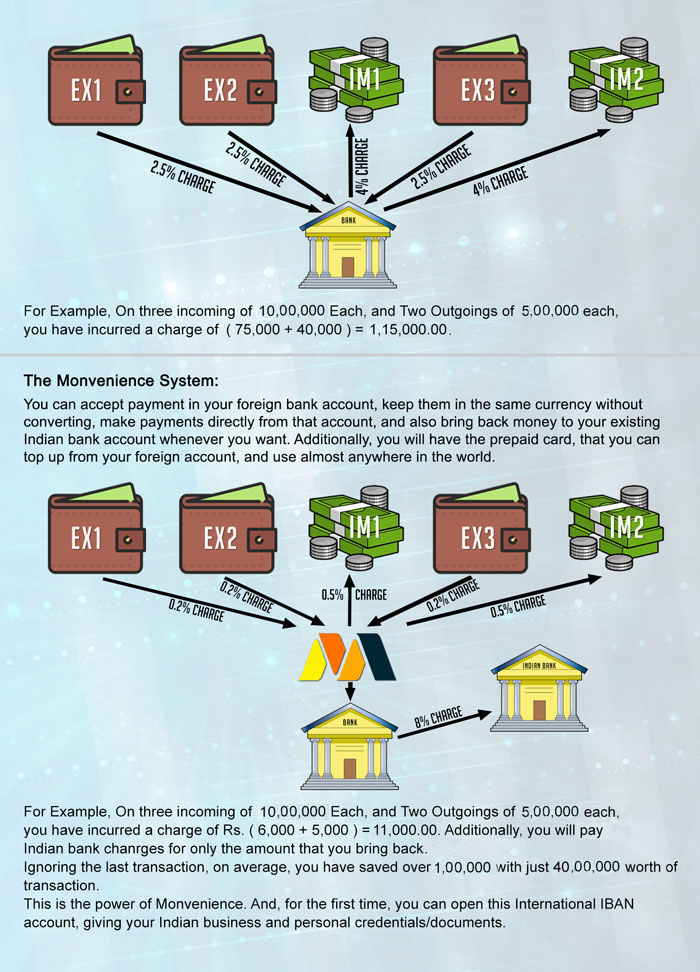
You also get competitive conversion at or close to the mid-market rate, and you can access EU payment gateways to collect payments from marketplaces such as Amazon. Banks tend to be restrictive with non-EU companies - asking for local address proof, large deposits, higher rates, and bundled products. A European IBAN account puts businesses of every size on an equal footing, using only home-country credentials.
Personal European IBAN accounts
You can also hold a personal European IBAN account with full remittance services and a dedicated IBAN. EU and UK passport holders may qualify for a free personal account; non-EU residents can hold the same account for a small charge. See the Monvenience homepage for current details.
One account, used across the globe
With a single account you can transact in multiple currencies across the Americas, Europe, Asia, and Australia, moving money across regions efficiently and at good rates.
Monvenience can also provide a fiat IBAN account to act as the fiat counterpart for a reputable digital-asset or crypto exchange, subject to compliance review and proof that you hold an account with that exchange. Apply online to find out the requirements.
Frequently asked questions
Can I open a European bank account online as a non-resident?
Yes. Operating under an EMI regulated by the Central Bank of Lithuania, Monvenience lets non-resident individuals and businesses from most eligible countries open a fully functional European IBAN account entirely online. You apply with your passport and home-country proof of address - no EU residency and no branch visit are required.
Is Monvenience a bank?
Monvenience is not a retail bank. It operates under an Electronic Money Institution (EMI) regulated by the Central Bank of Lithuania (Lietuvos bankas). An EMI is authorised under EU law to issue IBAN payment accounts, hold client funds under safeguarding rules, and process SEPA and SWIFT payments. EMIs cannot lend or pay interest, but for receiving, holding, and sending money they function as a European payment account.
What documents do I need to open a European IBAN account?
For a personal account you need a valid international passport and a proof of address (utility bill or bank statement) dated within the last three months. For a business account you also need company incorporation documents, a list of directors and beneficial owners, and a short description of your business activity. All documents can be submitted digitally.
Can a non-EU company open a European bank account?
Yes. A business incorporated and run in a country such as India, Canada, the UAE, or Singapore can open a European IBAN account without incorporating in Europe or holding an EU address. You apply with your domestic corporate documents and the passports and proof of address of the directors and beneficial owners.
Is my European IBAN dedicated to me or a pooled account?
Your IBAN is a dedicated account issued in your own name or your company's name - not a shared or pooled IBAN. A named, dedicated European IBAN is what payment platforms such as Stripe, PayPal Business, and Amazon Seller require for vendor and merchant onboarding.
How long does account opening take?
Standard KYC and AML verification takes 24 to 72 hours from the submission of complete, clear documents. Corporate applications, or applicants from jurisdictions requiring enhanced due diligence, may take longer. Submitting legible, English-language documents from the outset is the single biggest factor in a fast turnaround.
Which currencies are supported?
The SEPA account operates in EUR. A dedicated USD account with SWIFT reach in 200+ countries is available alongside it, managed from a separate dashboard - see above. The SWIFT multi-currency account supports more than 20 currencies in total, including EUR, USD, GBP, CHF, CAD, JPY, AUD, SGD, HKD, DKK, SEK, NOK, PLN, INR, MYR, CNH, HUF, RON, CZK, and BGN, all from a single login.
Who cannot open an account?
Applicants and businesses from FATF grey-listed and internationally sanctioned jurisdictions cannot be onboarded. Please check the list of restricted jurisdictions before applying.
Does the difficulty of opening a bank account vary by country?
Yes, significantly. Some countries have specific prerequisites (a tax number, an address registration, or a credit record) that a traditional bank requires before it will open an account, and non-resident onboarding timelines and requirements vary widely by country. See the country-by-country challenges table above for specifics, and the linked country guide for full detail.
Related pages
- Open an EU bank account online - LT IBAN for non-residents
- Online IBAN account for non-EU businesses and individuals
- European bank account rates & charges
- Multi-currency SWIFT accounts
- Global USD account
- Restricted jurisdictions
- Crypto debit card
- White-label IBAN solution
- Crypto and Stablecoin Enabled, Prepaid Card Platform in Whitelabel
- Crypto Enabled, SWIFT enabled, USD account for Corporates
Last updated: 3 July 2026

© 2026 All Rights Reserved.